Who Is Prauḍhamāyā?
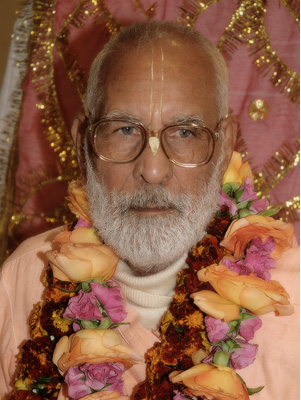
Twenty-two thousand pilgrims, both Indian and Western, attended the March 23–29 Navadvīpa-dhāma Parikramā of Śrī Devananda Gauḍīya Maṭha. Headed by Tridaṇḍi-svāmī Śrī Śrīmad Bhaktivedānta Nārāyaṇa Gosvāmī Mahārāja, this most dynamic parikramā visited the samādhi and bhajana-kuṭīra of Śrīla Jagannātha dāsa Bābājī Mahārāja, and the residence of Prauḍhamāyā and Vṛddha-Śiva, on the island of Koladvīpa, on March 24. Somehow, all the pilgrims were able to fit comfortably in the large sunny field just outside the samādhi, and there, on the western side of the Gaṅgā, Śrīla Mahārāja gave the following talk on the glories of Prauḍhamāyā.
By His own potency, Kṛṣṇa makes Himself bewildered. By the influence of Yogamāyā, Mother Yaśodā never knows that her son is Parabrahma, the Supreme Personality of Godhead, endowed with all opulence. Even Brahmā knows, so why should Kṛṣṇa, His friends, and Mother Yaśodā not know that He is God? Are Kṛṣṇa and Mother Yaśodā less than Brahmā? Here is the role of Yogamāyā. It is she who makes Kṛṣṇa’s naravata-līlā (human-like pastimes) possible.
When Kṛṣṇa is a little baby, He cannot turn over on His bed by His own endeavor. When Mother Yaśodā turns Him over, He feels so much pleasure and she also feels so much pleasure. She thinks, “Today my son did this and that,” or, “Today my son stole butter in so many gopīs’ houses.” She tries to bind Kṛṣṇa, but after tying together the ropes from all the gopīs’ houses, the combined ropes are still two fingers too short. Kṛṣṇa’s stomach is only twelve fingers wide, but still the ropes from all those houses cannot bind Him. Finally, when He is bound by the small rope from Mother Yaśodā’s hair, we find that this Parabrahma is crying. This Parabrahma, who can devastate unlimited universes, is now crying. This crying of Kṛṣṇa is natural and it is part of His līlā. It is not a drama. Due to Yogamāyā, He is actually mugdha, bewildered, not knowing anything. Who is not allowing Mother Yaśodā to bind Kṛṣṇa? It is Yogamāyā. When that same Yogamāyā sees Mother Yaśodā’s hard labor, she allows her to bind Him. This is the role of Prauḍhamāyā, Yogamāyā.
Who is Prauḍhamāyā? Just after Kṛṣṇa took birth from Mother Yaśodā’s womb, she gave birth to His sister, Yogamāyā. This is Prauḍhamāyā, a manifestation of Kṛṣṇa’s antaraṅga-svarūpa-śakti. The root or complete internal svarūpa-śakti, transcendental energy, is Rādhārāṇī. Śrīmatī Rādhārāṇī becomes samvit, sandhinī, and hlādinī in order to fulfill different functions and activities. Sandhinī is His existence potency, hlādinī-śakti fulfills all His desires, and samvit-śakti manifests all tattva-jñāna, all the way up to mādanākhya-mahābhāva. All bhāvas expand from samvit-śakti. The Lord and His svarūpa-śakti are the same. They are non-different.
Yogamāyā has two features. One is called Unmukha-mohinī, and she attracts Kṛṣṇa and all His parikaras (associates). Even though Kṛṣṇa is omnipresent and omnipotent, still she deludes Him and makes Him mugdha. How can He be bewildered? This is possible because He is the reservoir of all contradictory dharmas. Nothing is impossible for Him. On one hand He is nirguṇa, without any material qualities, and on the other hand He has all qualities and is always full of all opulence.
Apart from being endowed with opulence, Kṛṣṇa has another side, and that is His mādhurya side. His mādhurya-līlās are those which do not violate the human level of possibility. Those līlās that are para-laukika, not possible for any living entity to do, are His opulent or aiśvarya-līlās. In this way, Kṛṣṇa is omnipotent and mugdha at the same time. He is the Lord of lords, the origin of all incarnations, and at the same time He is Vrajendra-nandana. This is possible because He is endowed with aghaṭana-ghaṭana-paṭīyasī-śakti, that power which makes the impossible possible. Yogamāyā is that power.
The gopīs worshiped the demigoddess Kātyāyanī in order to get Kṛṣṇa as their husband. That Kātyāyanī, who was worshiped by the kanyā-kumārī gopī-gaṇa, is a partial manifestation of Yogamāyā, who is a partial manifestation of Śrīmatī Rādhikā. If we worship Śrīmatī Rādhikā, the worship of all Her manifestations is perfect. If we worship Śrī Caitanya Mahāprabhu, then Kṛṣṇa is worshiped with Rādhikā and all others. Therefore, Prauḍhamāyā manifests here in Navadvīpa and serves Śacīnandana Gaurahari.
The second feature of Yogamāyā is called Vimukha-mohinī. Vimukha-mohinī bewilders those who are averse to Kṛṣṇa. It was Vimukha-mohinī who appeared to Kaṁsa. When Kaṁsa heard the aerial sound saying that the eighth son of Devakī will kill him, Kaṁsa grabbed Devakī’s hair and was ready to kill her. It was by Yogamāyā’s influence that Kaṁsa was bewildered by the aerial sound. Although he believed part of the foretelling of the aerial voice, he could not understand that if it said he would be killed, then he would be killed.
Whereas Kaṁsa had no faith in Kṛṣṇa, Vasudeva, Kṛṣṇa’s father, had faith in Him. He knew that Kaṁsa would not be able to kill Devakī, but still he desired to be the via media for saving her. Later, when Kaṁsa picked up Yogamāyā from the hands of Devakī, Yogamāyā immediately became Mahāmāyā for him. When he was about to throw her on the rock, she flew up into the sky and chastised him. Those who are averse to Kṛṣṇa, like Kaṁsa, can only touch Mahāmāyā, not Yogamāyā. The word māyā consists of the two syllables, “ma” and “yā.” Mā-yā means that which is not what we think it is. All relationships in this world are not what we think they are. They are false; they are not eternal. We think that whatever pertains to the body is real, but it is not. Śrīla Bhaktivinoda Ṭhākura has therefore sung, “Gṛhe thāke, vane thāke. In whatever āśrama of life you are situated, chant, ‘Ha Gaurāṅga.’”
Mahāmāyā is the shadow of Prauḍhamāyā. That same Prauḍhamāyā becomes Mahāmāyā to those who are averse to Kṛṣṇa. Mahāmāyā covers our svarūpa, and for this reason everyone thinks, “I am a king,” or “I am a demigod.”
In Vṛndāvana, Yogamāyā is Paurṇamāsī:
rādheśa-keli-prabhuta-vinoda-
vinyāsa-vijñāṁ vrajaja-vanditāṅghrim
kṛpālutādyākhila-viśva-vandyāṁ
śrī-paurṇamāsīṁ śirasā namāmi
“I bow my head and offer praṇāma unto Śrī Paurṇamāsī-devī, who is completely adept at arranging the most elevated varieties of enjoyment for Śrīmatī Rādhikā, the mistress of Kṛṣṇa. Her lotus feet are worshiped by the Vrajavāsīs and, due to possessing the entirety of transcendental qualities starting with kindness, she is worshipable to everyone in the entire universe.”
śrī paurṇamāsyāś caraṇāravindaṁ
vande sadā bhakti-vitāna-hetum
śrī kṛṣṇa-līlābdhi-taraṅga-magnaṁ
yasyā manaḥ sarva-niṣevitāyāḥ
“I offer praṇāma to the lotus feet of Śrī Paurṇamāsī-devī, who is Bhagavān’s yogamāyā-śakti. She expands pure prema-bhakti for the feet of Śrī Rādhā-Kṛṣṇa, and her mind is always immersed in the ocean of Kṛṣṇa’s pastimes. I pray that she will immerse me also in those pastimes.”
Yogamāyā appears in Vṛndāvana in two forms. One is Paurṇamāsī, and one is Vṛndā-devī. As Yogamāyā Paurṇamāsī, she is the presiding deity of all Kṛṣṇa’s līlā. She is the samaṣṭi-gata-līlā-adhiṣṭhātrī-devatā (presiding deity) of all the pastimes of Kṛṣṇa, from birth to the end, and for all Rādhā-Kṛṣṇa līlā. Vṛndā-devī is the presiding deity of the confidential mādhurya-līlās that take place in the kuñjas, caves, and so on.
Śiva means auspicious. Śiva deludes those who are averse to Kṛṣṇa, and He is favorable to and helps those who are His devotees. Śaṅkara-tattva or Śiva-tattva is very complex. He is not Viṣṇu, nor is he a jīva. He is not māyā-tattva, but he is not beyond māyā-tattva. As Sadā-Śiva he is Viṣṇu-tattva. As Viṣṇu-tattva he is svāṁśa, a plenary portion of Kṛṣṇa. Also, when Kṛṣṇa incarnates in the three modes of nature, Śiva is the predominating deity of tamo-guṇa, the mode of ignorance. Brahma-saṁhitā states that Śiva is a combination of tamo-guṇa, the quality of minuteness of the marginal potency, and a minute degree of the mixture of samvit and hlādinī.
Source
Śrī Śrīmad Bhaktivedānta Nārāyaṇa Gosvāmī Mahārāja. Who Is Prauḍhamāyā? Lecture given during Navadvīpa-dhāma Parikramā in Koladvīpa, March 24, 2002. Transcribed and typed by Rādhikā dāsī; edited by Śyāmarāṇī dāsī. Originally published by PureBhakti.com.
This lecture and innumerable other lectures from Śrīla Gurudeva can be found at PureBhakti.com. Bhakti.bio exists solely to glorify and help share these transcendental teachings.